Following is an article that I wrote for Clarke University Alumni Magazine about my Aunt Barbara, who was an English professor at Clarke and also a nun in the BVM order. Sister Barbara Kutchera had a huge influence on my life. I hope you enjoy the article.
While growing up, I knew that my Aunt Barbara was a Catholic nun. But I had no idea how unique that fact was until I became a teenager. When the subject would come up, I would share the fact that my Dad’s sister was a BVM and taught in the English Department at Clarke College (now Clarke University). My friends would smile back at me as if I had said, “Mary Poppins is my nanny,” their mouths dropping open slightly, perhaps with one eyebrow raised or head cocked to one side.
Yet, like Mary Poppins, my Aunt – Sister Barbara Kutchera, BVM ‘59 – did have a conviviality, youthfulness, and even magic to her presence. She listened deeply to other people and made you feel heard. She spoke with great passion and enthusiasm about social justice issues, yet she was never angry or bitter. She was a Libra, as I am, an astrological sign represented by the scales, the symbol for fairness and justice. Perhaps it’s that spiritual-zodiac connection which makes me remember her mission to work towards social justice more acutely.
I remember her explaining to me and my siblings about boycotting grapes, for example, to support the United Farm Workers, facilitating a feeling that you too could make a difference in this world simply by deciding what not to purchase in a grocery store.
INVITATION TO DINNER
One of my most memorable moments with Sister Barbara was in the mid-1990s, when she led discussion groups and taught creative writing and poetry to incarcerated women at the Milwaukee County Jail, ministering to their hearts and minds. We both attended St Benedict the Moor church in downtown Milwaukee, just opposite the jail on State Street, which has a long history of social activism with a Capuchin-led feed-the-hungry program where church groups from around the city cook and feed homeless people.
She invited me to dinner one summer evening to join her as a woman was to be set free from a period of incarceration. We approached the side door of the jail, waiting there in the dirty alleyway for this woman, whom I’ll call Lucy. Sister Barbara told me a bit about her, then whispered that she may have been a prostitute. Just as the door clicked open, Lucy walked out in an enthusiastic hurry but then Sister Barbara approached her saying something like, “Are you Lucy? My name is Sister Barbara Kutchera. I work in jail ministry and I would like to invite you to dinner. My nephew, Joe, will join us too if that’s okay.”
And there was that look of suspended disbelief again, but this time from Lucy. Her facial expression conveyed a combination of, “Nuns still exist?” and, “Someone cares enough to invite me to dinner when I get out of jail?”
Lucy paused and then agreed to join us.
We drove to a modest diner nearby, ordered our meals and then Sister Barbara requested that we say a prayer. Lucy obliged and Sister Barbara thoughtfully prayed for Lucy’s new chapter of her life: for newfound freedom out of jail but also for the emotional and logistical challenges ahead in re-establishing oneself after being incarcerated. You could see in Lucy’s eyes that in receiving that prayer and being listened to, that Sister Barbara could bring someone closer to the Light.
Wherever and whenever she introduced herself as Sister Barbara Kutchera, emphasizing the fact that she was a nun, my Aunt could talk her way into or out of nearly anything that the holy spirit called her to do. Perhaps that was getting Lucy’s name from a security guard or getting access to the jail when she forgot her driver’s license.
I’ll never forget a moment when she joined me and my family for my graduation from Fordham University in New York City. As an evening of festivities wound down, I asked her where her hotel was. She told me that she was staying at a Friary at the corner of Thompson and Prince…for free. I replied, “That’s SOHO!” my eyes bulging open in surprise to Sister Barbara staying in Manhattan’s most expensive neighborhood. I asked her, “How did you arrange that?” She replied, “Oh when I called them, I told them that I’m a nun and that I’m here for my nephew’s graduation. And when I asked if there was a place to stay, they told me that clergy can stay free of charge.”
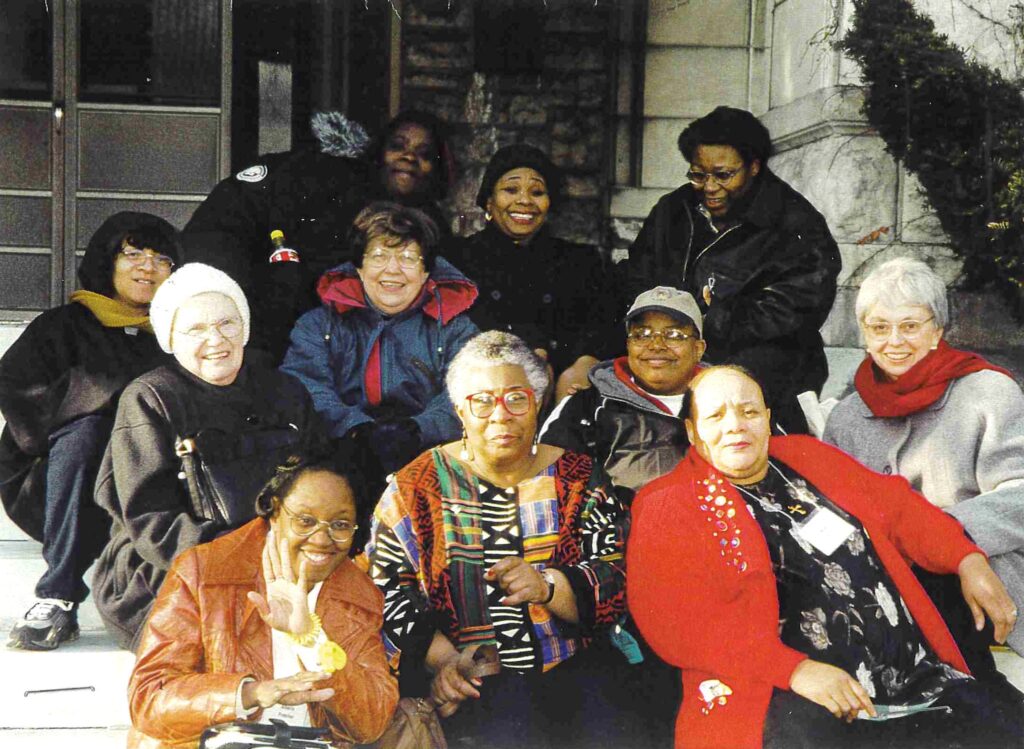
Sister Barbara Kutchera, BVM (center, in blue and red jacket) started The Shade Tree ministry site for African American women in Milwaukee with Sister Sue Effinger, BVM (at left in white cap) and Sister Helen Gourlay, BVM (far right with red scarf), pictured here with their clients in 2001.
CLARKE’S ENGLISH DEPARTMENT
Sister Barbara Kutchera taught in Clarke’s English department from 1964 to 1992, and even served as department chair. The holy spirit then called her to create a ministry site in Milwaukee, her hometown, for African American women, named The Shade Tree, which she dedicated herself to until the end of her life.
When I learned that Clarke’s English Department was to be discontinued, I wondered how she would have reacted to that news. Sister Barbara loved teaching literature. And through reading and discussing novels, she facilitated students’ understanding of human beings’ needs, wants and desires through analyzing a books’ characters. Societal tensions and inequalities, from Charles Dickens’ novels for example, could suddenly come alive in her classroom and enable students to see problems in our modern time.
“In everything she did, she gave her students valuable lessons about the dignity of each person – the “least” among us,” Moira Urich ‘82 wrote in Clarke Magazine’s summer 2005 edition. “This approach may have been unusual in many 19th-century British novel classes. But in Sister Barbara’s classes, literary themes were tied to contemporary injustices involving the homeless, gays and lesbians, or those trying to survive in war zones of El Salvador and Nicaraagua.”
The English Department was her baby of nearly 30 years, so surely, she would have felt devastated about this news. “High-cost, low-enrollment” programs with fewer than ten graduates per year were to be discontinued, including the English Department, so it was an economic decision that would focus the University on its strengths, its most in-demand majors.
The closing of other liberal arts universities paints a far more dire alternative to cost cutting and “organizational rightsizing.” For example, Cardinal Stritch University in Milwaukee and Holy Names University in Oakland, California, both Catholic, shut down in 2023. Lower birth rates since the 2008 recession have led to declining enrollments. This is compounded by the fact that a majority of Americans now question the value of a four-year college degree, causing some high school graduates to seek alternative career paths in skilled trades and to start working immediately after high school.
Yet, with a view towards the long term, Sister Barbara would have understood that this decision, however difficult, would enable Clarke University’s financial sustainability to bring the BVM Core Values far into the future. At the same time, she would be comforted to know that Clarke’s students will carry the torch of the BVM’s Core Values onward as Sister Barbara’s true passion was peace and justice.
But who is carrying the baton of those BVM values forward?
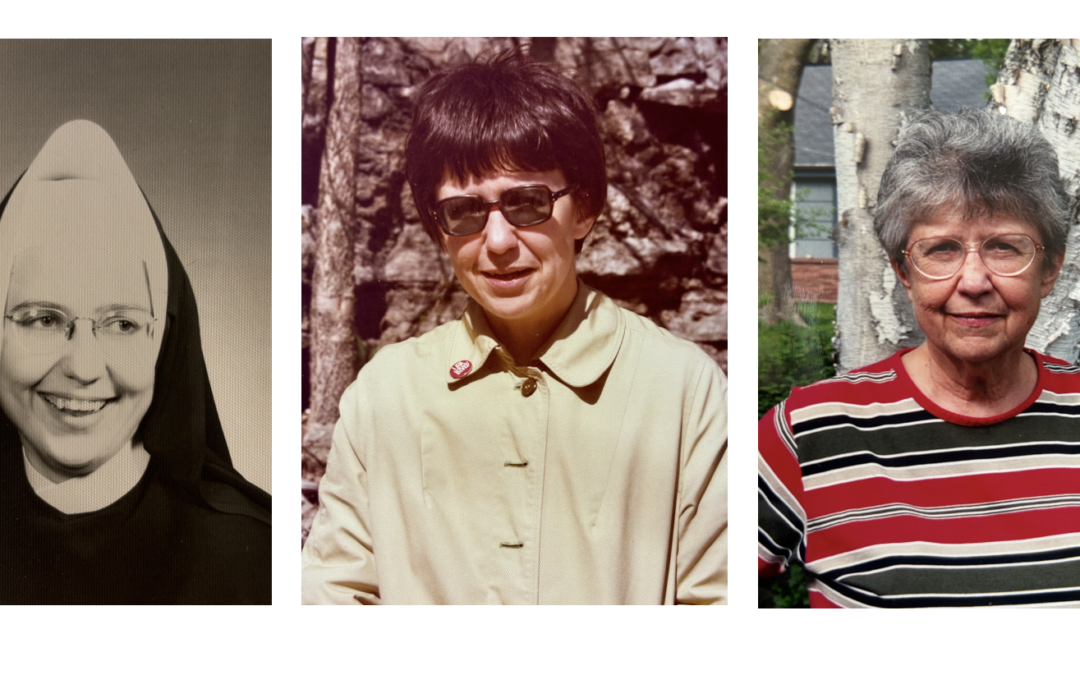
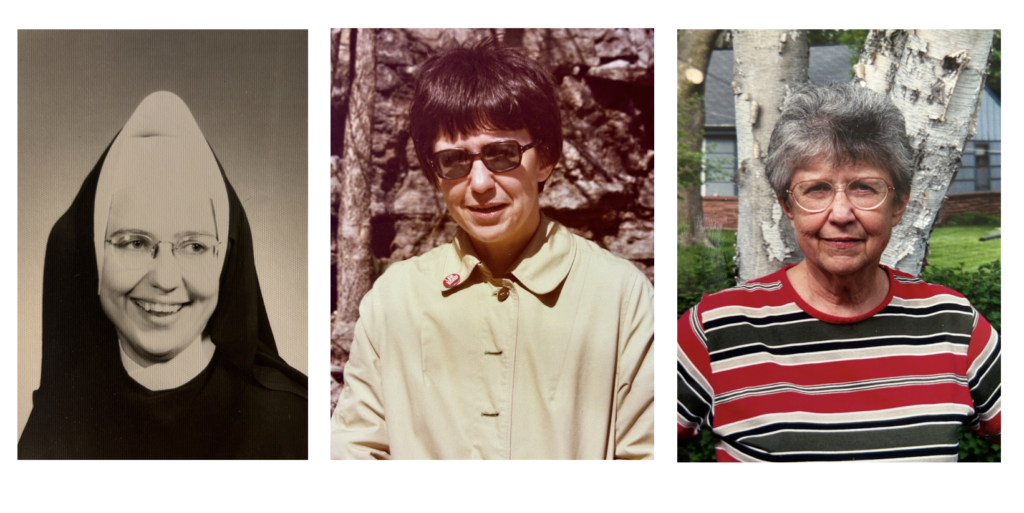
Two of Sister Barbara’s previous students from Clarke, Moira Urich ‘82 and Michelle Felix ‘88 established the Sister Barbara Kutchera Peace & Justice Scholarship in 2007, which aims to encourage students who have shown a commitment to peace and justice issues as well as provide financial assistance to them. Three Clarke English professors at the time also assisted in its creation: Katie Fischer ‘73, Sara McAlpin, BVM ‘56, and Pat Nolan, BVM. (See their photos below.) 75% of the funds go towards an annual scholarship for one student, who writes an essay and shows interest and leadership in peace and justice work. And 25% of the funds goes towards a social justice service trip during spring break every year, led by Rick Rupprecht, Director of Campus Ministry.
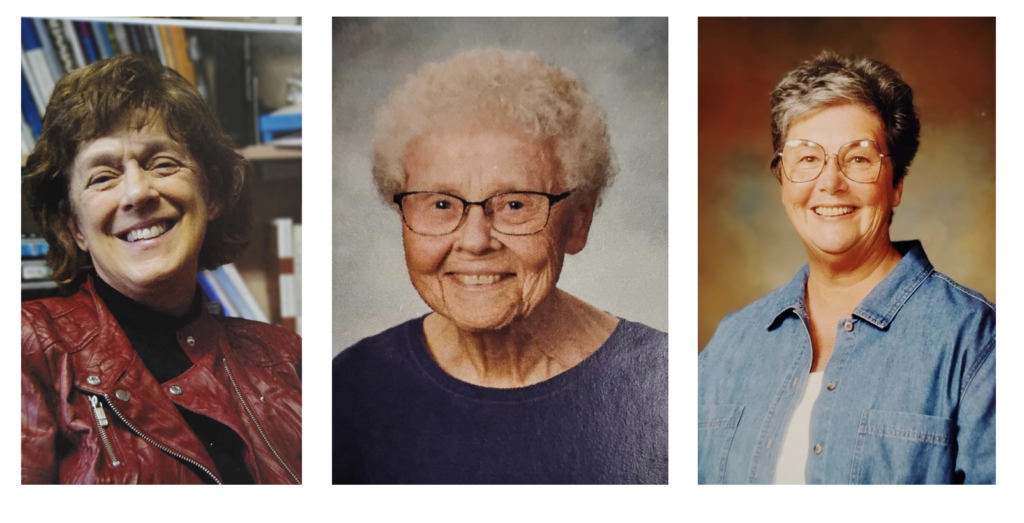
Rick invited me to listen to a presentation by the five students who went to Milwaukee on the Kutchera service trip during spring break 2025. The photos of Rick and the five students volunteering at Casa Romero Renewal Center, MacCanon Brown Homeless Sanctuary, and the Guest House of Milwaukee made me feel as though Sister Barbara’s spirit had returned to earth. But it was the photo of them below in front of the entrance to St Benedict the Moor church meal program that stopped me in my tracks, as if I were witnessing Rick and the students taking the baton of BVM values directly from Sister Barbara and delivering it into the present moment.
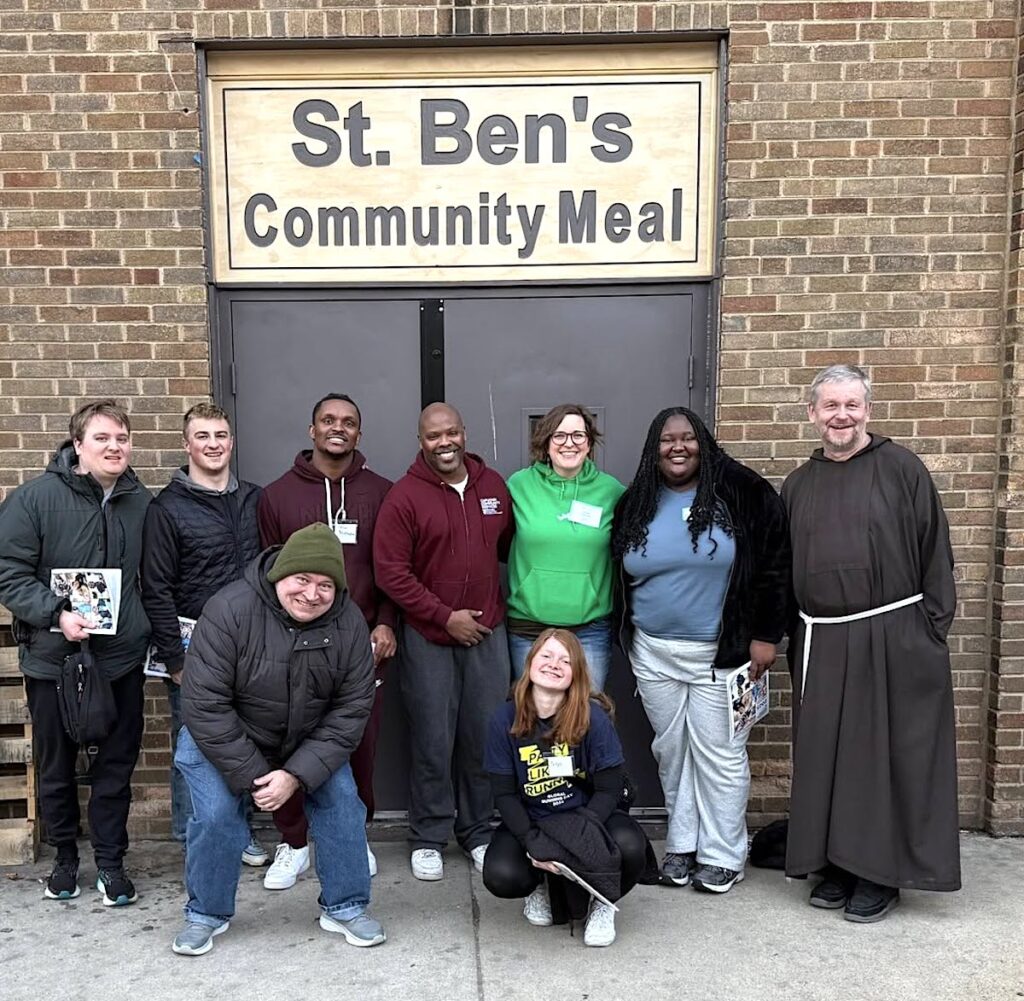
Brother Henryk Cisowski, at right, meets with Clarke University students and Rick Rupprecht, lower left with cap, Director of Campus Ministry at Clarke University, at the entrance of St. Ben’s Community Meal in Milwaukee, Wisconsin.
Shortly thereafter, another message of hope arrived in my email inbox. Lidia Marcela Fajardo ‘26, a student at Clarke University, originally from Honduras, emailed me to say thank you for being awarded the Sister Barbara Kutchera Scholarship. Her eloquent note of gratitude channeled Sister Barbara’s spirit so clearly. Yet, it also exemplified that there’s nothing more important than writing well, to convey what you want to say, no matter what discipline you study. With this in mind, I hope that Clarke’s students, no matter what they study, all take advantage of the dedicated Writing Center coaching and classes from Clarke’s Writing Faculty in Clarke’s General Education Curriculum. May the writing professors and instructors there carry the torch of Clarke’s former English Department forward.
NOOKS AND CRANNIES
When I was around nine years old, I remember visiting my Aunt Barbara where she lived on Alta Vista street, which means “high view,” with my younger brother and sister. On one of those visits to Dubuque, she asked us one weekend morning if we wanted to go on a walk to look for nooks and crannies. We cocked our head to one side and raised our eyebrows asking, “What are nooks and crannies?”
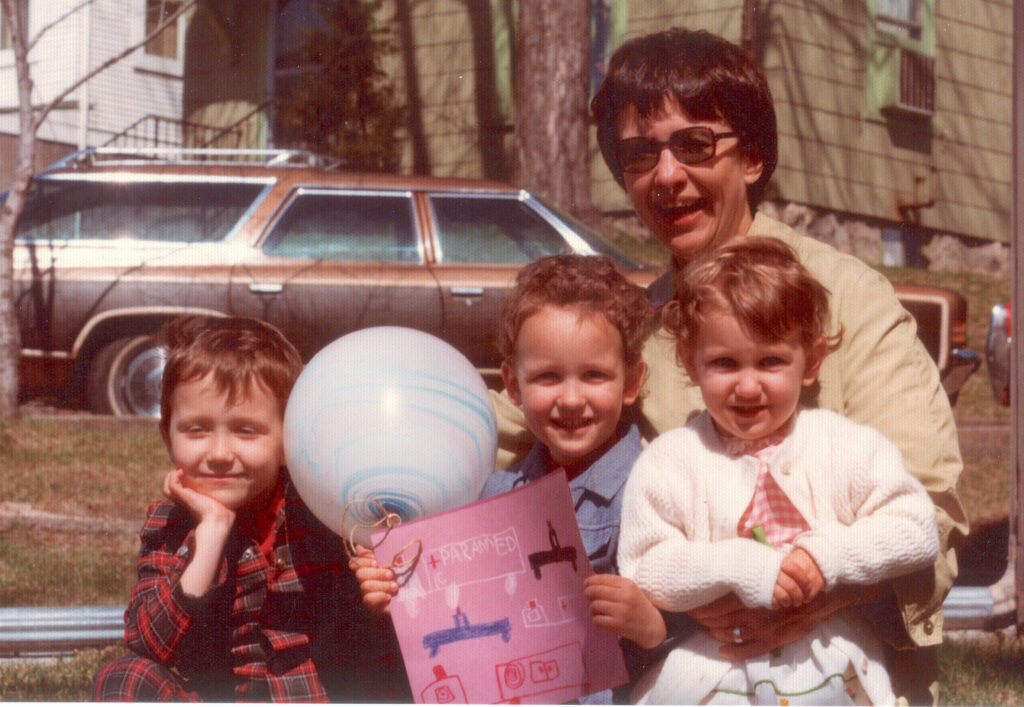
Sister Barbara Kutchera with Joe, Andrew, and Peggy Kutchera during a family visit to Dubuque, Iowa around the time they discovered nooks and crannies.
She explained that nooks and crannies are the small spaces that may be hidden or hard to find. Perhaps they were a perfect corner for cats to snuggle in. Or a shady porch nook, a perfect spot in which to drink a morning tea. That sounded magical and so we jumped at the chance to go on an adventure to look for something completely new. We walked around her hilly neighborhood with fresh eyes asking, “Is that a nook or cranny?” Each house we passed and every corner we turned, we looked for shady nooks inside windows or crannies between apartment buildings and asked for her affirmation that we had indeed found one.
I remember rounding a bend to see a cat in a small window, snuggled in the sunlight, perched above the living room of its owner. We laughed and thought how could we have been missing this?
My reality had been reset. It still holds a place in my memory like the scene in Mary Poppins when she shows the two little children how to jump into a chalk painting on the sidewalk. Anything is possible, it’s just a matter of adjusting your mindset.
Remembering that experience today, while living in a world where politicians, celebrities and social media influencers scream over one another, it seems quite difficult, even impossible sometimes, to see or hear the people hiding in the nooks and crannies in our society: the immigrants, the farm workers, the hungry. Yet they are there.
My Aunt Barbara’s spirit reminds me to keep an eye open for them, to see the beauty in all people. I can say with certainty that the good works of BVMs shine light into nearly every nook and cranny throughout Dubuque and everywhere they’ve worked. And to keep that spirit alive, we all need to look and pray for those in need, for the most vulnerable, and do good deeds to bring more light into the world.
To support the Sister Barbara Kutchera Scholarship at Clarke University, visit Clarke’s website and complete your gift using a credit or debit card. Select “Other” under designations and type “Sister Barbara Kutchera Scholarship” to direct your support, or contact development@clarke.edu with any questions.
For further reading, I recommend The End of The English Major, a 2023 article in The New Yorker, which explores the reasons why humanities enrollments in universities across the country have plummeted. And, in contrast, the number of students applying to STEM programs, which stands for “science, technology, engineering and mathematics,” has skyrocketed as a result of beautiful new campus buildings and the allure of higher incomes.