Posts Tagged ‘spanish’

Part III – Doing Business in Puerto Rico: Understanding and Managing a Bi-cultural and Bi-Lingual Work Environment

January 29th, 2012

Tweet This article originally appeared in the Fordham Business Review. I recently re-discovered it and wanted to share it here as I found it very relevant today for executives that work in the Caribbean or Latin America. Click here to read the first and second posts in this series. Cultural Identity: Between the United States and Latin America Mr. Molina feels that Puerto Ricans differentiate themselves from the United States culturally and politically through the term “La nación,” (The Nation). “The nation is a cultural

read more...

Part II – Doing Business in Puerto Rico: Understanding and Managing a Bi-cultural and Bi-Lingual Work Environment

January 28th, 2012

Tweet This article originally appeared in the Fordham Business Review. I recently re-discovered it and wanted to share it here as I found it very relevant today for executives that work in the Caribbean or Latin America. Click here to read the first post in the series. Cultural Impact: Beyond Language José Molina illustrates that communicating in English goes way beyond language. American business people respect interrupting and getting your point across; whereas, in Latin America they value position power and formal hierarchy. “The higher

read more...

Part I – Doing Business in Puerto Rico: Understanding and Managing a Bi-cultural and Bi-Lingual Work Environment

January 27th, 2012

Tweet This article originally appeared in the Fordham Business Review. I recently re-discovered it and wanted to share it here as I found it very relevant today for executives that work in the Caribbean or Latin America. In the century since July of 1898 when Puerto Rico became part of the United States, Puerto Rico has experienced incredible changes due to the influx of not only American tourists, but more importantly American business executives and entrepreneurs. They have provided a significant number of jobs to

read more...

Connecting “Like A Good Neighbor” on Facebook: Tips for Building your Spanish-Language Facebook Page from State Farm

July 8th, 2011

Tweet This article originally appeared on MediaPost. How should marketers customize a Facebook initiative for the U.S. Hispanic market? State Farm’s Aymee Zubizarreta answered that question during our recent conversation about how the insurance giant found its voice and connected to its Latino audience with content about music, family and culture on the leading social network. Q: This past April, State Farm became the first national insurance company to create a bilingual (English, Spanish) social networking site for Latinos. Why did State Farm launch a

read more...

On Endangered Cultures and Languages, the Rise of Globish, and Bilingualism

November 19th, 2010

Tweet I watched this presentation on TED.com months ago from photographer, Phil Borges about the loss of endangered languages and cultures and I couldn’t get it out of my head. The photos, personal stories, and statistics that Borges shared blew me away, especially the opening paragraph: A fact came out of MIT, couple of years ago. Ken Hale, who’s a linguist, said that of the 6,000 languages spoken on Earth right now, 3,000 aren’t spoken by the children. So that in one generation, we’re going

read more...

Latino Mavens: The Influence of Spanish-language Teachers in the U.S.

November 10th, 2010

Tweet Hispanic marketers and researchers often discuss the growth of the U.S. Hispanic audience and their acculturation process into American society. But rarely do we analyze the opposite side of the same coin. How do Caucasians learn the Spanish language, acquire information about Latinos’ native countries in Latin America, and “acculturate” to a more Hispanic America? As the Hispanic population grows, speaking Spanish becomes more useful than ever before. Many American students choose to study Spanish because of its usefulness here in the U.S. or

read more...

What’s in your word cloud? (Data visualization ideas)

June 29th, 2010
LatinoLink-Wordle

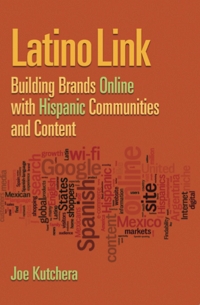
Tweet While doing research about data visualization for my book (Latino Link: Building brands online with Hispanic communities and content), I stumbled upon the website Wordle, where you can build “beautiful word clouds.” According to the site, “Wordle is a toy for generating “word clouds” from text that you provide. The clouds give greater prominence to words that appear more frequently in the source text. You can tweak your clouds with different fonts, layouts, and color schemes. The images you create with Wordle are yours

read more...

Smash Fear, Learn a Language…or Tango Dancing

May 14th, 2010
timferriss

Tweet So often, when friends learn that I speak Spanish, they tell me, “oh yeah, I studied Spanish in high school but I don’t remember anything. I’m not good at learning languages.” If I could have a nickel every time I heard that, I think I’d be a millionaire. Tim Ferriss’ video on TED.com below highlights how he learned Japanese, Tango dancing and how to overcome his fear of swimming. “Fear is your friend,” he says. It can point you to what you can do

read more...

Why Does Google Send U.S. Hispanics To Foreign Web Sites?

May 18th, 2009

Tweet This article originally appeared on MediaPost and is an early preview of Latino Link: Building brands online with Hispanic communities and content from Paramount Books. Put yourself in the shoes of a bi-lingual or Spanish-preferring U.S. Hispanic and try searching in Spanish on Google, Yahoo or MSN and what do you find? A good portion of the results, sometimes approaching 50%, come from sites based in Mexico, Spain, and other Spanish-speaking countries. Let’s look at some examples I found recently on the first page

read more...

Connecting Via Mobile: Speak Their ‘Edioma’

January 17th, 2009

Tweet This article originally appeared on MediaPost’s Engage:Hispanics blog. Where will many Hispanics and other Spanish-speakers around the world first experience the Internet? Interestingly, because they lag behind the general population for Internet access, many will first go online via their cell phones. In fact, they significantly over-index when consuming mobile content. According to comScore m:metrics, 71% of Hispanics consume content on cell phones compared to the market average of 48%. In addition, Hispanics tend to notice and respond well to ads on cell phones.

read more...
Page 1 of 212»